
Direction not destination...
The pivot (part 1)

During the last year a lot has been changing inside my head. Or at least that’s how it seems.
As promised in my previous post, A Creative Collision of Collaborative Curiosity, I’m attempting to unpack and explore this. With the caveat that you’ll be kind to me if it all goes a bit ‘wonky’.
During the first three months of the year, a lot of my time was spent preparing to publish a new novel, We Are Not Anonymous. It’s a near future novel, partly inspired by the sub-genre Thrutopia.
As the big tech billionaires became even more prominent it was apparent that the traditional route of finding an agent, a publisher and then entering the publisher’s queue, would result in a ‘near-past’ novel by the time it came out. That said, the idea of taking on all the admin and marketing and making it financially viable was daunting.
I remember the exact moment I stood on the beach at Camber Sands contemplating this conundrum.
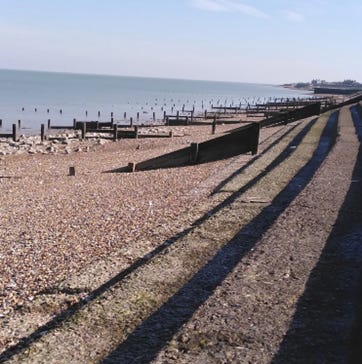
Being of the punk generation with various forays into the margins of society, I’m attracted to the DIY culture and as I let my mind expand and drift with the waves, I remembered that it’s up to me to choose how I go about things.
After letting the sea metaphorically wash away the more obvious options in front of me, my understanding crystallised into the idea that I could treat ‘me’ as a single ‘business model’. What I realised was that it all interweaves - the fiction, the applied sci-fi, the speaking gigs, and so on. That was the moment when Nudge the Future Fiction was born; seeing myself and what I do as one holistic whole.
One of the more enjoyable aspects of setting this up was working on the logo with the artist Kim Hutson, and here’s the result:
At the same time, I was getting my head around Zoefuturism.
Yen Ooi, who coined the term, had asked me to co-edit an issue of Vector, the British Science Fiction Association’s critical journal. Over coffees, we talked about the concept and, as I began to comprehend more, I found it affecting how I viewed the world, helping to solidify things I’d been thinking for a long time. For example, seeing things through the lens of direction rather than destination. But it also took me to places I hadn’t considered before, especially about legacy, children, and being in the general ‘flow’ of time rather than having a life lived between x and y dates. I say a bit more about this in the guest-editorial of the first issue, which is due out soon.
Here’s what we said in the call for papers:
“Zoefuturism takes its name from the Greek word for life, zoe (ζωή, zoí). It is a futurism of connectedness, engagement, and relationality, a futurism of ‘life-becomings.’ Inspired by the study of zoetology that was coined by Prof Roger Ames, and the fact that DNA in all living things are bringers of change, zoefuturism explores the reality of human nature as human ‘becomings’ (rather than ‘beings’) where constant change rooted in all nature is acknowledged as fundamental to living. Though this inspiration is from ancient East Asian philosophy, zoefuturism doesn’t belong within one culture or philosophy. It is a concept that is shared throughout innumerable teachings around the world that is ancient and new, encompassing many philosophies, knowledge systems, teachings, way of lives, and religions.”
During these first three months of 2025, I was busy with the editing process of Brain Fruit, described as “A mind-bending, bio-digital fable that pulses with poetic strangeness.”
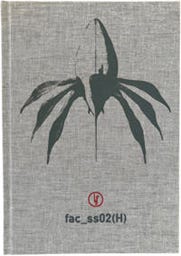
The writing of this novella, which was released later in the year by the wonderful publisher L’il Factory AB, was heavily influenced by my interactions with Zoefuturism. Writing it in this frame of mind (and with this publisher) was incredibly liberating, was a departure from my usual near-future work, and is proving to have been a pivotal endeavour. And then, having this story published in a limited edition, carefully crafted hardback, designed to age with use, was amazing and fitted perfectly with where my thinking was at.
Also during this time, an episode of the Futures Podcast hosted by Luke Robert Mason went live, giving me an opportunity to reflect on the work I’ve been doing with Applied Science Fiction and more generally on becoming a writer. I’ve been interviewed by Luke before, and he’s one of the best at making you comfortable whilst also being insightful with his questions. Although, I kept whatever was going on inside my head about the direction of my thinking under my hat (so to speak).
So, back to those 3 pretentious phrases I used in the previous post - authentic not algorithmic; author as artist; change as a relational constant.
I think the decision to treat me and my writing holistically was a move towards being more authentic and thinking about zoefuturism was helping me see change as a relational constant, helping me view the world and my place in it differently.
That said, they were only the beginning of something that played out across the rest of the year; that’s for the next instalments.